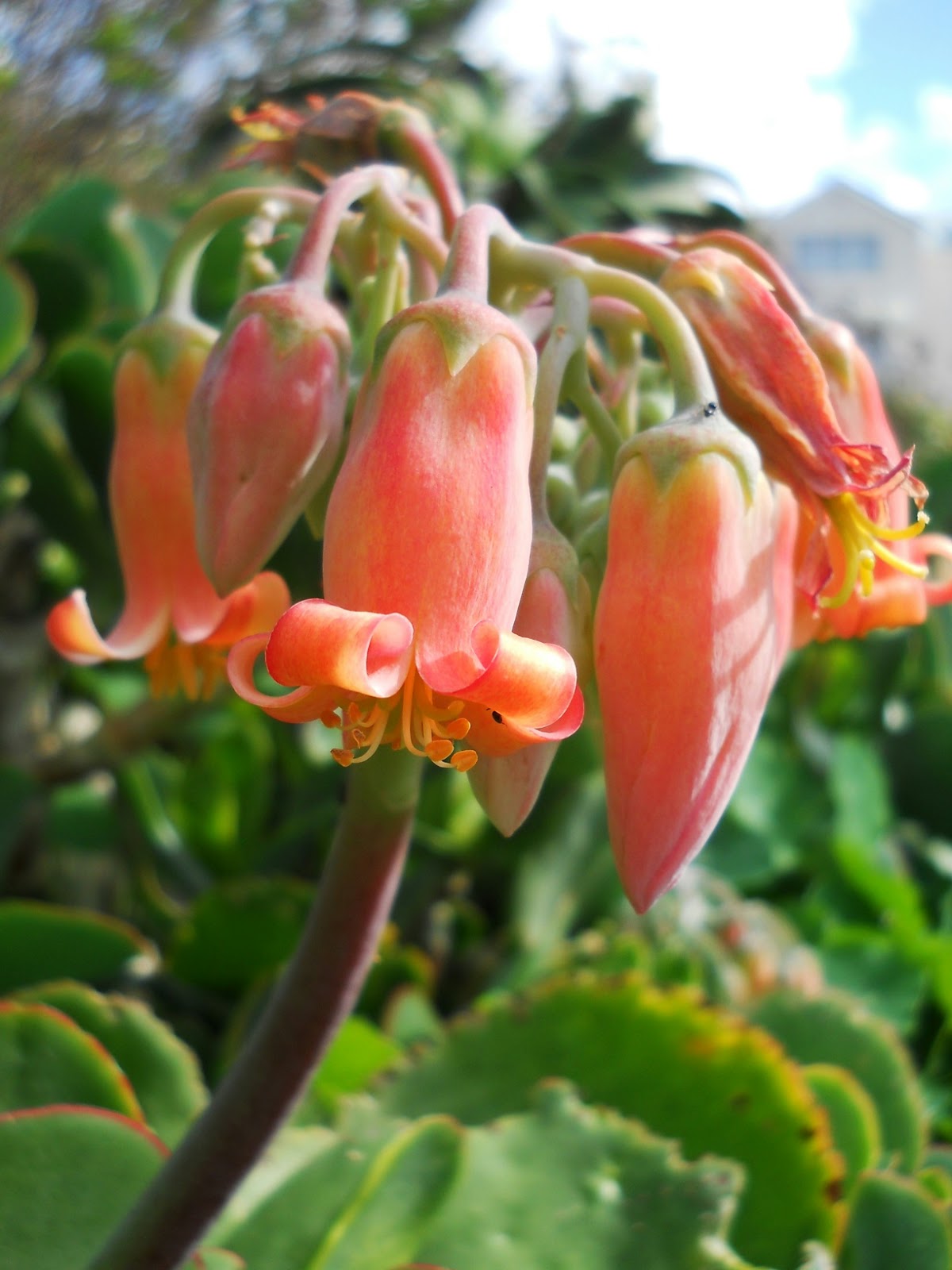
I can imagine a future where each person has to carry a plant around with them because there's no guarantee that there will be enough oxygen wherever they are going. I think (hope) that this is just imagination and that this will never happen. But I can still imagine it being a possibility and I think that that is a problem. People shouldn't have to live in a world where everyday we worry about the future. It's very sad and this is why we, as humans, should be sustainable. It is not something to fix at the 11th hour or the 99th minute, because sometimes things are beyond fixing and as time goes much more slowly for the Earth. It took the Earth millions of years to get where it is today, do you think that anything will change fast? It won't. Fortunately it seems that people are aware of this and more and more people are changing their thoughts and ways every day. This is what make me feel a bit better. These thoughts circle continuously in my brain. Whenever people bring up the future and what it could be like one day if we don't change, I start to panic. People don't like change, what I they don't change? Then I remind myself that people are changing, even if it's slowly and that's good. We as individuals need to be sustainable and plant some trees or something, because think about it - one day it could be a lot more difficult lugging your personal plant around with you than it is to plant few more now.
Wednesday, 9 September 2015
SA AoC Reflection that Nicci sent 22 August 2015 South Africa
I can imagine a future where each person has to carry a plant around with them because there's no guarantee that there will be enough oxygen wherever they are going. I think (hope) that this is just imagination and that this will never happen. But I can still imagine it being a possibility and I think that that is a problem. People shouldn't have to live in a world where everyday we worry about the future. It's very sad and this is why we, as humans, should be sustainable. It is not something to fix at the 11th hour or the 99th minute, because sometimes things are beyond fixing and as time goes much more slowly for the Earth. It took the Earth millions of years to get where it is today, do you think that anything will change fast? It won't. Fortunately it seems that people are aware of this and more and more people are changing their thoughts and ways every day. This is what make me feel a bit better. These thoughts circle continuously in my brain. Whenever people bring up the future and what it could be like one day if we don't change, I start to panic. People don't like change, what I they don't change? Then I remind myself that people are changing, even if it's slowly and that's good. We as individuals need to be sustainable and plant some trees or something, because think about it - one day it could be a lot more difficult lugging your personal plant around with you than it is to plant few more now.
Tuesday, 28 July 2015
SA AoC Simonstown Reflections 25 July 2015 South Africa
Saturday was terribly cold in Muizenberg, the wind was icy! So we held AoC conversations here in Simons Town. I'll send through some photos too. Next week, we'll hopefully go to Muizenberg beach, if it's a little warmer.
The conversations focused on Andy Fisher's concept of the pains of capitalism, and the way that the system is set up to create a sense of shame. We also looked at Rollo May's modern day idols: conformity, apathy, materialism and social hierarchies, and the way they sometimes blind us.
Here are the reflections:
1). How Is it that when so many have become aware of the negative side-effects of climate change, that so much of lifes daily routines remain unchanged?
Motor car sales have increased. And so too the emissions emitted.
Imagine that every car driver on Earth was issued a can of poison gas and told to open it and take it along with them for their daily travels. Imagine, smiling, waving and even hooting and shouting at your fellow drivers in the daily traffic, as your allotted can hisses out its toxins. Imagine going to the office, school, shops, friends and then home, with the can, all the while spilling out its daily allocation of assorted noxious gasses.
Imagine doing this everyday, every month, every year, always...
Now imagine living in a city with your friends, loved ones, children and pets, beautiful animals and plants
..and millions of little gas canisters.
2). "You're face to face with the man who sold the world."
It upsets me how some people care so much more than others and how they have to work even harder to make up for the arrogance of other people. I don't understand how people can care more about themselves and their pockets being lined with money than they care about other people.
Some behavior sickens me and makes me feel guilty to be human. People have done unforgivable things to the earth.
I think many, if not most people want to be good, but society is so twisted and difficult to untangle and correct. Sometimes I just feel really sad about the situation all people find themselves in.
I think people who care just have to do their best.
3). I've been thinking about the way we're shown how to focus on what we present to the world. It's often connected to what we can buy, or how we show ourselves on social media. And yet I feel most comfortable when I can forget about those things and be with people who connect and share. It's helped me to shape something new and start to explore it. And it's helped me to see how imagination can create a sense of solidarity or exploration that includes 'others'.
As we've spoken about the despair we feel at the deaths, extinctions and injustices, I thought about how much the world matters to us, and how we're learning to see beyond the fears, doubts and anxieties consumerism creates, and into something deeper.
We have new fears, but we can see through the manipulation and explore our empathy for the earth. And that is helpful.
Wednesday, 15 April 2015
Nicci Attfield reflects on South Africa and AoC work 9 April 2015
....'I think it's true that the ideas are shaping and changing because of the AoC work. It's a little bit difficult with my writing, because writing about social sculpture and taking part in AoC are two totally different things. AoC is about freedom, sensitivity, awareness and agency (because we speak and share, and because we connect to a wider community, as one of the children pointed out so intuitively). And the questions I am asking have also emerged because of Agents of Change. I've been learning about food, and how it was controlled through agriculture as a way of moving people into industry. I have also been learning such a lot about the social impacts of development on communities.
In South Africa, so many communities are struggling because of the development of mining and one group of people said that if you want to take a way a community's identity, then you chase away the ancestors. If you do that, the community will die off. The woman then explained that the ancestors live on a particular site that is going to be mined. She explained that her community will be destroyed because the ancestors will leave or abandon them.
My overall question now is how human and environmental rights intertwine? Can we ever fulfill our human rights if we mistreat the environment? And how do we get to understand different ways of being so that we can understand that there are not only single ways of being in the world (the ones we might be most familiar with through education). As I'm sitting and watching or listening, I am increasingly beginning to understand that the way that we are living isn't right.
AoC has been very lovely because it attracts very diverse people. Everybody feels as though it's okay to take part, and there is a lot of freedom to speak and share. I haven't seen anything like this before, and particularly the openness. My previous ways of looking at difference may just have perpetuated the divides between people. I'm understanding that realizing this was a part of my process, and a part of working reflexively. I also realize that AoC has changed my life in many ways, and that even as a person who studied diversity, I now have greater insights into different ways of being or living with the world than I had before. And this is why I really believe we are doing something very good for all people who want to reflect, share or listen to themselves or other people'....
In South Africa, so many communities are struggling because of the development of mining and one group of people said that if you want to take a way a community's identity, then you chase away the ancestors. If you do that, the community will die off. The woman then explained that the ancestors live on a particular site that is going to be mined. She explained that her community will be destroyed because the ancestors will leave or abandon them.
My overall question now is how human and environmental rights intertwine? Can we ever fulfill our human rights if we mistreat the environment? And how do we get to understand different ways of being so that we can understand that there are not only single ways of being in the world (the ones we might be most familiar with through education). As I'm sitting and watching or listening, I am increasingly beginning to understand that the way that we are living isn't right.
AoC has been very lovely because it attracts very diverse people. Everybody feels as though it's okay to take part, and there is a lot of freedom to speak and share. I haven't seen anything like this before, and particularly the openness. My previous ways of looking at difference may just have perpetuated the divides between people. I'm understanding that realizing this was a part of my process, and a part of working reflexively. I also realize that AoC has changed my life in many ways, and that even as a person who studied diversity, I now have greater insights into different ways of being or living with the world than I had before. And this is why I really believe we are doing something very good for all people who want to reflect, share or listen to themselves or other people'....
Thursday, 26 March 2015
SA AoC group reflects on freedom. Observatory CT SA 22 March 2015
1) I think that education is very important for creating awareness of the world. If you teach people to care and love and heal, then you will get people who want to do things for good reasons. People are not superior to each other, the animals or the earth. By destroying our world you also destroy people. If the trees are gone, then people will not be able to breathe. If the water is polluted we cannot drink. Our needs are connected to the earth. People have been telling each other that we don't need the earth. I think it is time to accept that we do need the earth. We need it to live. Once we accept that it will make an important difference. People need our Mother Earth to nurture us and teach us and we need to love and nurture her too. (Danny)
2) My thoughts at the moment are about what I need vs what I'd like to have (or even what I think I might like to have). Realizing how sacred mountains can be mined, and rivers diverted, livelihoods threatened and cultures and identities broken down, for coal which benefits only a few people makes we question how we live. What do I actually need, what do I sometimes find more convenient, and what is adding to or making problems? We need water but we don't need the dyes and chemicals that get added. I wonder about the choices I've made, and the ones I would have made differently if I had been able to see more holistically. I'm also seeing how human and environmental rights are very intertwined (nicci)
3) There's such value in positive re-inforcement as opposed to horror stories and scare tactics. This work is healing work. It's healing the broken hope. It heals the guilty conscience and warms our hearts to positive change. No matter how slow, it is still a change in the right direction. If everything that is in the world was just originally dreams or ideas then repairing, reducing and caring are also ideas in my head that could oneday become a reality.
Sunday, 1 March 2015
SA AoC at Two Rivers Ocean Park Cape Town 28 February 2015
Today, we spoke about freedom. These are our reflections:
People don't really have the freedom to knowledge. Businesses often don't tell all of the information about a product, because they know that what they are doing is not ethical or good. But then people will buy their product or service, and themselves become unethical, even without their knowledge. Often businesses don't admit these things because then people won't buy their stuff. This means that people will not often want to support groups that survive at others' expense. (For example, people often don't know that clothes are made in sweat shops or products are tested on animals). Basically, businesses lie to the public to get what they want, which I think is extremely wrong. People should not be supporting bad causes without knowing it.
I love willow trees, I love how they look like they have long thin arms which are reaching out, or maybe they just have long hair. (Danny).
Not everyone or every living creature has the right to be free. Freedom is something we should enjoy, and not take advantage of. Not everyone has freedom. Those who have should treasure it. Some people have to fight to be free, while others get it handed to them on a silver platter. Don't take advantage of something so special, that not everyone has the right to. Living creatures do not have the right to anything. Trees are cut down without even a thought. They are killed without consent.
We need to protect this world we live in because one day it might not be here anymore. We should protect things while there is still a chance for survival, and not when it is too late. (Raeesa).
Can the aspect of freedom not only relate to human beings, but plants and animals as well? We speak of freedom, and of how we are free as human beings, but how free are we? Our freedom is restricted, and limits one to be seen as conventional. Why can't we have a variety and difference in our lives instead of living in a black and white world of conformity? We relate freedom to human beings, but freedom can as well be applied to animals and plants. Even though plants cannot speak the human language, they can emit vibrations. Why can't plants and trees be as they are? Environmental rights of animals and plants matter too. Even though animals do not speak English, they do have their own language that humans may not understand. If humans invade their habitat, they do communicate, and should have the right to freedom as well (Lauren).
How do we live well, rather than living rich? How did we learn to believe we should live rich? Capitalism speaks about creating a need, and it did create a need by taking people out of sustainable life, and from family, and forcing people to work and leave home to do things like work in the mines.
The system was set up to benefit few and create consumers rather than connected people. We should have freedom to be, rather than have to prove yourself over and over again as productive and worthy. Freedom could be about about time to spend in long conversations or exploring your child's perceptions of the world. Or freedom to eat healthily because food isn't full of toxic chemicals. I'd like to have freedom from the cruelty of factory farming and freedom to create. It would be helpful to have freedom from products which damage the environment or other people. Freedom to disconnect from the idea that real work is connected to power or prestige would be helpful too. Cooking for a family is nourishing work, and yet people may still be seen as unemployed. I think we need the freedom to define work as that which brings value or makes a difference. (Nicci).
Levels of freedom range from being physically imprisoned, to being a wandering nomad. There is financial freedom, but what is that? There is also also the importance of freedom from physical threat. There's the freedom of food, shelter, family and love. How is it that traditional people had to give up this to enter into a capitalist system to earn money? In exchange for money, people risk physical safety, proper shelter and healthy food choices. Sometimes they experienced loss of community and family support. When people had to travel from their homes to 'the land of opportunity' they crossed imagined borders that turned them into criminals if they didn't have the right (invented) documentation to grant them legal access.
The whole system has been created to make menial and ridiculous jobs and procedures to perpetuate itself, and to protect the very few. (no name).
Thursday, 15 January 2015
Danny Attfield Reflects on SA AoC in 2014
Agents of Change helped me rediscover what I realize is a very deep respect for nature. It helped me express my feelings about the environment and my anger and sadness about what people have done to the Earth.
Agents of Change itself allows discussion about the environment without making anyone feel guilty or telling people "It is your fault that there is global warming because you don't recycle!" It also taught me about the environment and how everyone is connected.
It gave me a space to feel very peaceful and write poems or meditate even when I was feeling upset or anxious.
I think that Agents of Change has helped me to become a more calm person and worry a bit less about everything in general. It is nice to think of solutions instead of just stating that there are problems or scaring everyone into not leaving their taps to drip because it would basically lead to the collapse of society.
Agents of Change has helped me believe that I can actually help, even if my contribution is small. Ripples always start out small. Thank you Agents of Change.
Agents of Change itself allows discussion about the environment without making anyone feel guilty or telling people "It is your fault that there is global warming because you don't recycle!" It also taught me about the environment and how everyone is connected.
It gave me a space to feel very peaceful and write poems or meditate even when I was feeling upset or anxious.
I think that Agents of Change has helped me to become a more calm person and worry a bit less about everything in general. It is nice to think of solutions instead of just stating that there are problems or scaring everyone into not leaving their taps to drip because it would basically lead to the collapse of society.
Agents of Change has helped me believe that I can actually help, even if my contribution is small. Ripples always start out small. Thank you Agents of Change.
Wednesday, 7 January 2015
SA AoC Science Center Cape Town 7 January 2015
I had a surreal experience during the holidays while I was standing in the Supermarket. I'd always thought it was full of food, but when I looked around me, I saw manufactured products that are harmful to health, plastic bottles of water or sugared and coloured drink, and stuff that people don't need. I thought about the plastic in the sea, and all of the bags that harm wildlife. It had always been a problem I saw as existing "out there", something that people were doing, but not me. But I began to realize the amount of rubbish that leaves my house every week, taken and disposed of somewhere I can't see. I saw how unnecessary so much of what I buy without thinking actually is. I'm going to change that. Even just cooking your own food, washing a spoon or drinking water from the tap can reduce the amount of throw away plastic. By making these little changes, I can make a contribution. (no name).
We live in a plastic world
Where we drive toy cars
And eat cardboard food
We live in a plastic world
Where we scoop the oceans
And burn the trees
We live in a plastic world
Where we weave plastic lies
With our sewing lips
But our world isn't only plastic
We can make it stone and wood again
We can turn the grey to green
We must stop making our world plastic
Otherwise we too become plastic
A little more everyday
(Danny)
Listening to the different thoughts today, from the children feeling joy and wonder at the outside world, to adult (and teen) sadness at all of the plastic in the oceans and in landfills, I realized how much I love our process, because it gives space to everyone, and acknowledges all feelings and perspectives.
Just before New Year, I realized how reluctant I was to get involved in a conversation about equal rights and equal voices, because some of the people started telling somebody else what to think. I was worried that if I got involved or tried to share, it could make things worse, and the conversation could become hurtful (this happened before). At that time, I realized how much I love this work, and how much space there is to share and explore when there is empathy and respect. It really is a relief to work in this way. We need all different perspectives and many voices to add to our conversations. (Nicci).
Subscribe to:
Posts (Atom)